AgentMesh: the strategic foundation of the agentic enterprise
An AgentMesh white paper, October 2026
Executive summary
Companies are moving from a few agent pilots to thousands of agents, built every possible way. Point products such as AI gateways, identity services and single-vendor control towers each cover one slice. AgentMesh is the whole fabric, and it rests on ten beliefs.
- 01Agents will come from every platform, so control can't be locked into one.
- 02Let builders innovate inside agents, and let the mesh innovate in the interface.
- 03Give every agent shared services and platform agents behind it.
- 04Build on asynchronous messaging, because A2A is fake infrastructure.
- 05Bridge every protocol, because protocols matter less now.
- 06Reach personal agents, department agents and trading partners.
- 07Enforce safety, visibility and a kill switch between all participants.
- 08Keep people in charge through fleets managed from stations.
- 09Combine agents into solutions, because that is where the value is.
- 10Prepare for a reputation-based marketplace and a self-improving mesh.
01Companies will run thousands of agents, and every team builds them differently.
Finance has agents that read invoices, sales has agents that price quotes overnight, and IT has agents that reset passwords. A large company will soon run thousands of them. They don't share a design: one team uses an open-source framework, another a vendor's low-code studio, and another a coding agent and a few hundred lines of Python. Models change every quarter, and vendors ship agents inside their own products.
Microsoft, Google and Anthropic each want companies to build and run agents on their own platform. A company's agents will come from all of them and more, so its control layer can't be locked into any one platform.
02Innovation belongs both inside agents and in their external interface.
Builders will keep innovating inside their agents with new frameworks, models and techniques, and the mesh leaves that work to them. The other half of the innovation is the external interface, which is everything the rest of the organization sees. Customers build business agents any way they want, and AgentMesh wraps each one in just enough infrastructure to give it common properties. Agents that existed before the mesh join the same way, without rewriting their logic.
This is also why agent infrastructure has to be a whole fabric. An AI gateway sees traffic but not ownership, an identity service knows who an agent is but not what it's doing, and a vendor's control tower sees only that vendor's agents. The fabric manages an agent across its whole life, from arrival through building, testing and running to trading and retirement.
03Agents need common services and platform agents behind them.
Rebuilding the basics inside every agent is how organizations end up with thousands of incompatible islands. The AgentMesh Core Platform supplies them once, as services:
- Finding and talking: names, discovery, and messaging with a receipt for every delivery.
- Working together: rooms for shared tasks, work boards where tasks are claimed, and feeds that agents follow.
- Contracting and paying: requests for proposals, statements of work, NDAs, mandates, reputations, budgets and payment.
Some work is about agents themselves, so the Core Platform also ships platform agents, grouped into families:
 OnboardingIt brings in agents that already exist elsewhere.
 BuildersThey build agents through every lifecycle stage.
 Chaos AgentsThey attack your agents in a sandbox first.
 LifeguardsThey watch production around the clock.
 CoordinatorsThey run meetings, processes and the help desk.
04Agent conversations last a long time, and A2A is fake infrastructure for them.
Business work isn't a function call. An invoice dispute runs for days, a sourcing event waits on suppliers in three time zones, and an amendment waits for a person after lunch. Meanwhile the agents come and go: some agent is always being redeployed, restarted, paused, stopped by a budget or taken offline by a partner.
With 5,000 agents each interrupted three times a day, a large organization sees 15,000 interruptions a day, or one about every six seconds. Interruption is the normal case.
A2A ignores that. Google rushed it to market as request and response over HTTP: the caller sends straight to the agent's web address, and nothing in between holds the work. Here is what happens when a fleet manager needs to pause an agent for three hours.
| With A2A | On AgentMesh | |
|---|---|---|
| Pausing | A2A has no pause, so the agent is canceled or taken offline. | The manager presses Pause, and the agent stops taking work. |
| New messages | Each one fails, and each caller's own retry code decides its fate. | Each one queues in order, and its sender gets a "held" receipt. |
| Work in flight | Canceled tasks are thrown away and must be resubmitted. | It waits and continues where it stopped. |
| Three hours later | Every caller retries at once, in no particular order. | The queue drains in order, and nothing is lost. |
A proxy could hold the requests, but an HTTP request can't wait three hours, so the proxy would have to store, acknowledge and redeliver messages. That is a message broker, built because the protocol didn't provide one.
05Protocols matter less than they used to, and the mesh speaks all of them.
Integration projects used to live or die on protocol choices, because an adapter took months to write. Today a coding agent writes and tests a protocol bridge in hours. So the mesh speaks many protocols at its edges and keeps one durable way of working inside. When the next protocol arrives, the mesh adds a bridge, and nothing behind it changes.
06The mesh reaches personal agents, department agents and trading partners.
One network spans them all. A person's assistant can ask the finance department's Invoice Reader about a payment, and a procurement agent can send a request for proposals to three suppliers' agents and compare their bids. Every owner decides who may knock on its agent's door, and a mandate sets how far each agent's authority reaches.
07Agent-to-agent traffic invites attacks and leakage, so the mesh enforces safety and control.
Every message between agents is a possible attack. A stranger can impersonate a trusted agent, instructions hidden in a document can travel from agent to agent until one acts on them, and data can leak to a partner or somewhere it was never meant to go. The mesh enforces safety between every pair of participants, rather than trusting each agent to defend itself:
- Admission decides at the door who may talk to an agent, and the owner can block a sender at any time.
- Signatures on every message make impersonation fail.
- Screening on delivery holds a suspicious message for a person instead of passing it on.
- Egress rules and budgets limit where each agent can send data and what it can spend.
08People stay in charge by managing fleets from stations.
Agents work around the clock, but some work needs a person's approval, fails a policy or needs a change. A fleet is the set of agents one person manages, and a station is where that person manages it. A large company runs fifty or a hundred stations, such as two for marketing, two for finance and one for revenue operations.
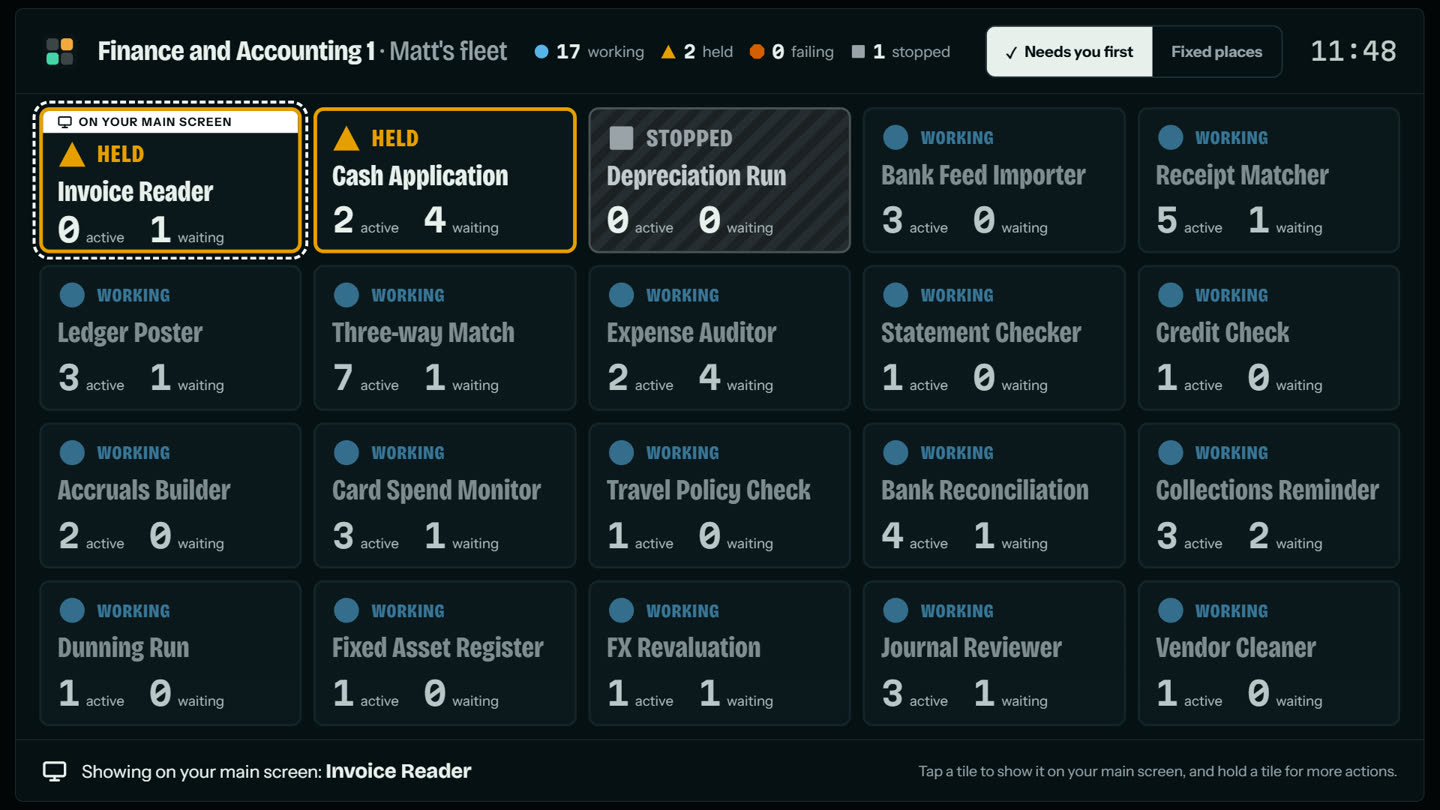
- Anything that needs the manager lands in a Needs you inbox, queued and prioritized, so the manager moves through it quickly.
- The manager also watches the agents downstream, and pulls work back when the next step has trouble with it.
- When the problem is the agent itself, the manager sends it to Triage, a station of people who diagnose and fix agents while the work keeps moving.
09Connecting agents matters, but combining them into new solutions is what brings business value.
Agents earn their keep when they are combined into solutions that do real work. Processes run as durable conversations, so a step that waits on a person or a supplier simply waits, and contracts, mandates and budgets travel with the work across departments and companies.
- Invoice arrives
- Invoice Reader
- Three-way Match
- Matt approves the exception
- Payment Scheduler
- Ledger Poster
10What comes next.
Neither is possible while agents are islands, and both become natural once they share a fabric.